

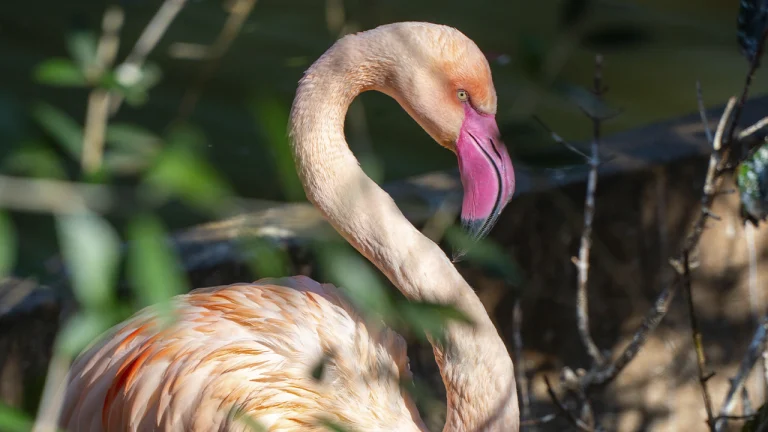
(Phoenicopterus roseus)
The greater flamingo is one of the most emblematic and recognizable waterbirds in the world thanks to its elegant figure and distinctive pink plumage. It inhabits salt lagoons, marshes, and wetlands of Africa, southern Europe, and southern and southwestern Asia. In Spain, it is commonly found in Doñana and the Mediterranean salt flats.
Characteristics of the greater flamingo
This bird can reach up to 1.5 meters in height and a wingspan of 140–165 cm. Its pink plumage is due to the intake of carotenoids present in small crustaceans and algae. It is distinguished by its long S-shaped neck and slender legs that allow it to walk in shallow waters. Its downward-curved beak acts as a filter to extract food from the water.
Diet of the greater flamingo
It is a specialized filter-feeder that mainly consumes small crustaceans, larvae, mollusks, and microscopic algae. Its carotenoid-rich diet is responsible for the pink hue, which becomes more intense with age.
Conservation of the greater flamingo
The greater flamingo is not considered globally endangered, but it depends on well-preserved wetlands to survive. The loss and pollution of these ecosystems are its main threats. Protection programs have been implemented to safeguard its breeding and resting areas.


