

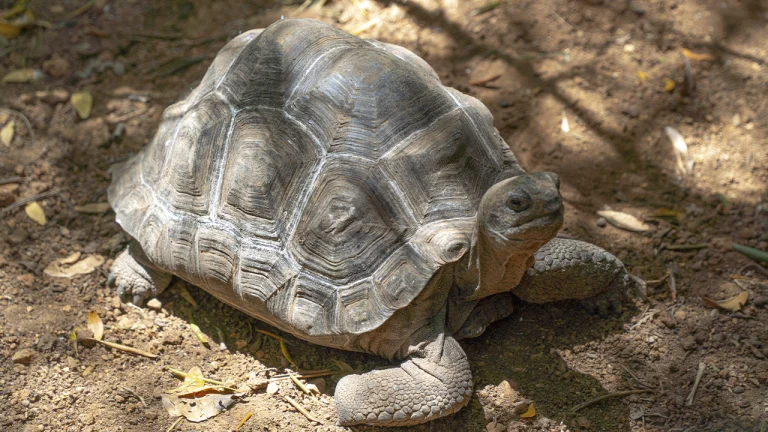
(Geochelone sulcata)
Distribution
It inhabits a strip of land located at the upper edge of the Sahara, stretching from Mauritania and Senegal to Ethiopia and Eritrea. This strip is about 8,000 km long and 500 km wide, known as the Sahel.
Description
Males have 2 or 3 spurs on their hind legs, while females do not. They have 4 claws on the hind legs and 5 on the front legs. Males are larger than females. They can live over 100 years.
The base color of the shell is dark brown, and each scute has a border of this color around its entire perimeter. Young specimens may show a spot on the scutes, and the edge of the scute is darker than the rest; this difference disappears around 5 years of age.
The head is rounder than in other tortoises and has a yellowish tone. The skin is very thick. The supracaudal scute is divided.
Measurements: males up to 85 cm in length and 100 kg, females up to 70 cm and 70 kg.
It is the third-largest tortoise species after the Galápagos and Seychelles tortoises. Two subspecies are known, eastern and western, which differ in color tone.
Habitat
It lives in the hot, dry savanna, almost desert-like, sometimes with acacia woodlands and thorny shrubs.
Diet
In tortoises, diet is very important, as an inadequate one can quickly cause shell deformities. They can eat dry grasses, hay, and succulent plants. Occasionally, they consume carrion. In captivity, they should not eat meat or fruit, only fresh grasses, lettuce, hay, and hibiscus flowers.
Reproduction
Males are aggressive during mating, biting and ramming the female, which may be seriously injured. Egg-laying takes place from October to May. The female usually digs the nest under a bush, with a depth of 20–70 cm and about 30 cm wide. Within minutes, she lays between 10 and 35 eggs, and in a year she may lay 2 to 6 clutches.


